History leaves scars.
Some are written in concrete and steel.
Some are written in silence.
And some… are written in the quiet lives of animals left behind.
Nearly forty years after the disaster at Chernobyl, the Exclusion Zone still stands as a haunting reminder of what happened in 1986. When families fled the invisible danger, many were forced to leave their pets behind.
The doors closed.
The buses left.
And the dogs stayed.
Today, their descendants roam the abandoned streets and the rusting remains of the power plant — living echoes of a past the world has tried to move beyond.
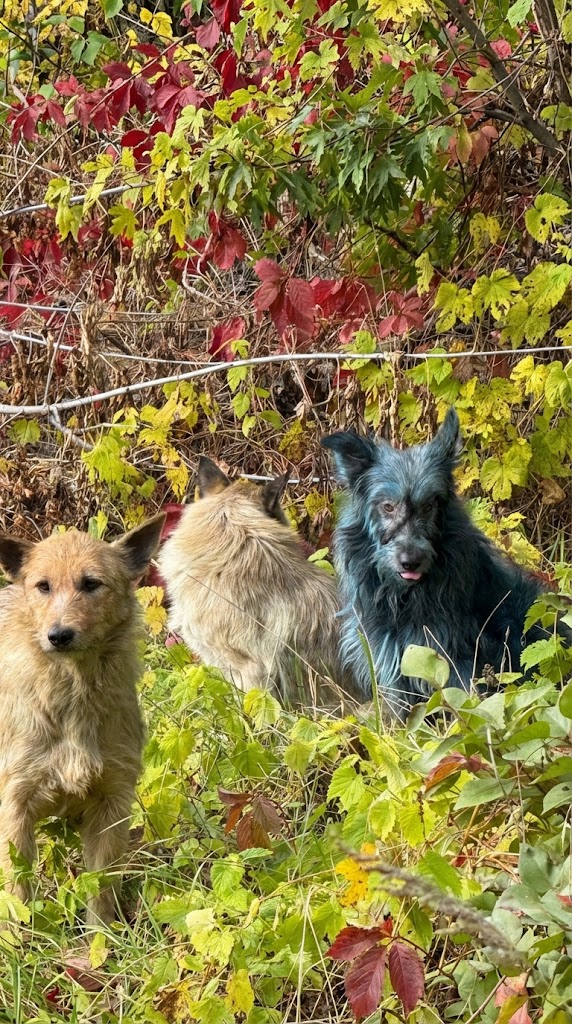
So when photos of bright blue dogs began circulating online, fear spread quickly.
Had radiation finally changed them?
Was this the proof people had always dreaded?
The images were startling.
Stray dogs wandering among concrete ruins… their fur tinted an unnatural sapphire blue.
In a place already associated with mutation and long-term radiation exposure, imaginations ran wild.
But sometimes, even in the most extraordinary places, the explanation is surprisingly ordinary.
VIDEO: The Blue Dogs of Chernobyl — A Surreal Sight in the Exclusion Zone
Not Science Fiction — Just Curious Dogs
Teams working inside the zone, including animal welfare volunteers, quickly investigated.
The dogs were not glowing.
They were not ill.
They were not genetically altered.
They had simply been doing what dogs often do.
Rolling.
According to field veterinarians, the blue color came from a leaking portable toilet. The bright dye inside had transferred to their fur after they found it and treated it like a playground.
It wasn’t radiation.
It was curiosity.
And aside from their unexpected new look, the dogs were active, alert, and healthy.
In a place defined by catastrophe, the truth turned out to be refreshingly simple.
VIDEO: Inside the Exclusion Zone — The Daily Mission to Protect and Monitor the Dogs
Life in the Shadow of History
Today, an estimated 500 dogs live within the Chernobyl Exclusion Zone.
They are descendants of the pets left behind during the evacuation. Over decades, they have formed semi-wild packs, adapting to harsh winters, limited resources, and an environment humans no longer inhabit permanently.
Living there is not without risk. Radiation levels still require visitors and rescuers to carry monitoring devices and follow strict safety protocols.
Yet the dogs endure.
Genetic research suggests that the Chernobyl dogs are now distinct from other dog populations in Eastern Europe — shaped by isolation and time. Whether radiation played any role remains part of ongoing scientific study.
But what is undeniable is their resilience.
The People Who Refuse to Forget Them
Behind every surviving pack is a network of compassionate volunteers.
Since 2017, teams have entered the zone regularly to vaccinate, tag, sterilize, and provide medical care for more than a thousand animals. Their work helps stabilize the population and protect the dogs from preventable disease.
But perhaps the most meaningful act is the simplest one.
Feeding.
Each trip requires planning and care — navigating checkpoints and designated safe paths — all to bring food to animals who gather near the ruins, waiting patiently.
Waiting not for ghosts.
But for kindness.
VIDEO: Feeding the Forgotten — Bringing Warm Meals to the Dogs of Chernobyl
More Than a Viral Image
The blue dye will fade.
It will wash out in rain.
It will grow away with new fur.
But the story behind those photos remains important.
In a place long defined by tragedy, life continues — sometimes in surprising, even humorous ways.
These dogs are not symbols of mutation.
They are symbols of endurance.
They are reminders that:
• Nature adapts, even in the most unlikely places
• Not every strange sight is a disaster
• Compassion can cross even the most restricted borders
Today, the dogs of Chernobyl live beneath open skies and beside crumbling buildings. They are studied, cared for, and remembered.
They are no longer just “strays.”
They are survivors.
And in the quiet rhythm of their daily lives — walking, resting, waiting for food — they carry forward a story the world will never fully forget.